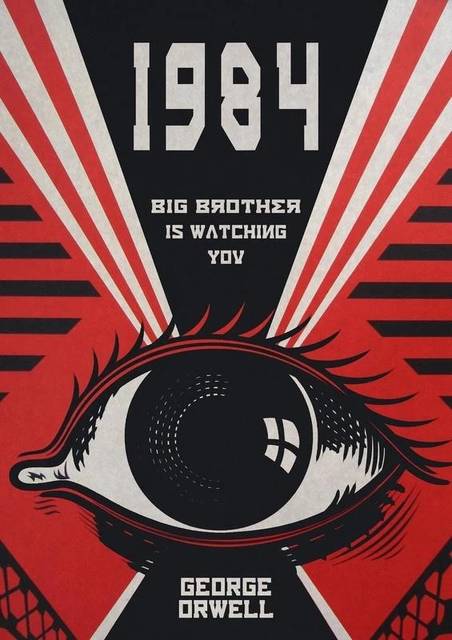
1984
Gorge Orwell
1949
Nineteen Eighty-Four, 1984 is a dystopian fiction form probably one of my favorite writers, Gorge Orwell. The story behind the book is of particular interest to me. As you can see, the book was originally written in 1949, Orwell tried to foresee the future, how would the world be like in 1984? In his “foreseen future”, he had imagined a dystopian version of the world. A world where personal freedom and individual thought are sabotaged by authority. A world where sanity is statistical, (Google search this phrase ;)).
Now, for the most part, the world didn’t really turn out as bad as he had imagined, but all the while I was reading this book, I had moments where I could relate to the things that were depicted in the story. Many of the things he predicted in 1949 about the world are relatable today. This is absolutely fascinating to me. I sincerely believe that Orwell was ahead of his time, his predictions may not have come true in 1984, but traces of his predictions feel true today. This is scary as well as fascinating. The world he imagined is not a pretty one!
Now, I must inform you that this book is pretty mind-boggling. There are two full-length crash course videos trying to explain the meaning of ideas in this book. I am by no means smart enough to fully understand the depth of issues the author depicts within the flow of the story. And no, this is not some book that just goes on talking about boring philosophical ideas. The genius of Orwell, I think, is how he tells such an interesting story that captivates the reader all the while quietly inserting pieces of really profound ideas into one’s head. When you read this book, you kind of feel there is something deeper going on but you do not quite understand what it is, all the while enjoying such an amazing story. It makes you feel a peculiar way which I cannot describe; you need to read it to feel it!
With that being said (and not giving the story away!), here are some excerpts from the book that I found particularly interesting.
- Was he then, ALONE in the possession of a memory?
- Why should one feel it to be intolerable unless one had some kind of ancestral memory that things once looked different?
- He might be alone in holding that belief and if alone, then a lunatic.
- They were like ants which can see small objects but not the large ones.
- It struck him that in moments of crisis one is never fighting against an external enemy but always against one’s own body.
- At the sight of I love you the desire to stay alive had welled up in him, the taking of minor risks suddenly seemed stupid.
- Listen, the more men you have had, the more I love you. Do you understand that? Yes perfectly. I hate purity, I hate goodness! I don’t want any virtue to exist anywhere. I wa t everyone to be corrupt to the bones.
- That was above all what he wanted to hear. Not merely the love of one person but the animal instinct, simple undifferentiated desire; that was the force that would tear the party to pieces.
- In the old days, he thought, a man looked at a girl’s body and saw that it was desirable and that was the end of the story. But you could not have pure love or pure lust these days. No emotion was pure, because everything was mixed up with fear and hatred. Their embrace has been a battle, the climax a victory. It was a blow struck to against the party. It was a political act.
- The theory was that men, whose sex instincts were less controllable than those of women, were in great danger if being corrupted by the filth they Handled.
- With Julia he had no difficulty in talking about such things; Cathrene, in any case had long ceased to be a painful memory and became merely a distasteful one.
- It was merely that sex instinct created a world of its own which was outside party’s control and therefore destroyed if possible. What was more important was that sexual privation induced hysteria, which was desirable because it could be transformed j to was fever and leader worship.
- He wondered vaguely whether in the abolished past it had been a normal experience to lie in a bed like this, in cool of a summer evening, a man and a women with no clothes on, making love when they chose, talking of what they chose, not feeling any compulsion to get up, simply lying there and listening to peaceful sounds outside.
- For the first time in his life he did not despise paroles or think of them merely as an inert force which would one day spring to life and regenerate the world.
- The paroles had stayed human, they had held on to the primitive emotions which he had to re-learn by conscious effort.
- But the inner heart whose workings were mysterious even to yourself remained impregnable.
- The object of waging a war is always to be in a better position in which to wage another war.
- For if leisure and security were enjoyed by all alike, the great mass of human beings who are normally stupefied by poverty would become literate and would learn to think for themselves and when once they had done this, they would sooner or later realize that the privileged minority had no function and they would sweep it away.
- The sealed world in which he lives would be broken and the fear, hatred and self-righteousness on which his morale depends might evaporate.
- It was the product of a mind similar to his own but, enormously more powerful, more systematic, less fear-ridden.
- The best books, he perceived are those that tell you waht you already know.
- There then rose schools of thinkers who interpreted history as a cyclical process and claimed to show that inequality was unalterable law of human life.
- The new middle groups in effect proclaimed their tyranny beforehand. Socialism.
- Inequality was the price of civilization.
- But no advance in wealth, no softening of manner, no reform or revolution has ever brought human equality a millimeter nearer.
- Indeed, so long as they are not permitted to have standards of comparison, they never even become aware that they are oppressed.
- Hereditary aristocracies have always been short-lived, whereas adoptive organizations such as the catholic church have sometimes lasted for hundreds or thousands of years.
- The discontent produced by his bare, unsatisfying life is deliberately turned outwards by such devices as the two-minute Hate.
- In our society, those who have the best knowledge of what is happening are also those who are furthest from seeing the world as it is.
- If human equality is to be for ever averted – if the high, as we have called them, are to keep their places permanently – then the prevailing mental condition should be controlled insanity.
- Bring in minority, even a minority of one, did not make you mad. There was truth and there was untruth, and as long as you clung to the truth even against the whole world, you were not mad.
- Sanity is not statistical.
- Where there is equality there is sanity.
- It felt natural to exist moment to moment, accepting another ten minutes life even with the certainty that there was torture at the end of it.
- Of pain, you could wish only one thing: that It should stop. Nothing in the world was so bad as physical pain. In the face of pain there are no heroes, no heroes.
- You would not make the act of submission which is the price of sanity.
- Reality is not external. It exists in human mind and nowhere else. YOU ASSUME EVERYONE ELSE SEEMS THE SAME THING AS YOU.
- That the choice for mankind lay between freedom and happiness, and that for the great bulk of mankind happiness was better.
- But it was Alright, everything was all right. The struggle was finished. He had won victory over himself. He loved big brother. The end.
The book is really good, well written and really makes the reader think about things in a different way. However, the only downside of this book is that is simply too complicated at times for the reader to understand. A better way to put it would be, the profoundness of the book is at times simply too large for the reader to be able to actually enjoy the story. The author at times spends too much time in describing the mental nuances of the characters, which may make the reader the loose track of where the story is heading.
All in all, with everything considered, this is an amazing book. Anyone who has enough patience, to take the time to try and understand the things the author wants to tell the reader through the story would absolutely love this. However, this book might not be the best choice for someone who is looking for a causal novel to enjoy. You need to give much time and thought to enjoy this book to the fullest.
= )
 Honestblogs